Table Of Content

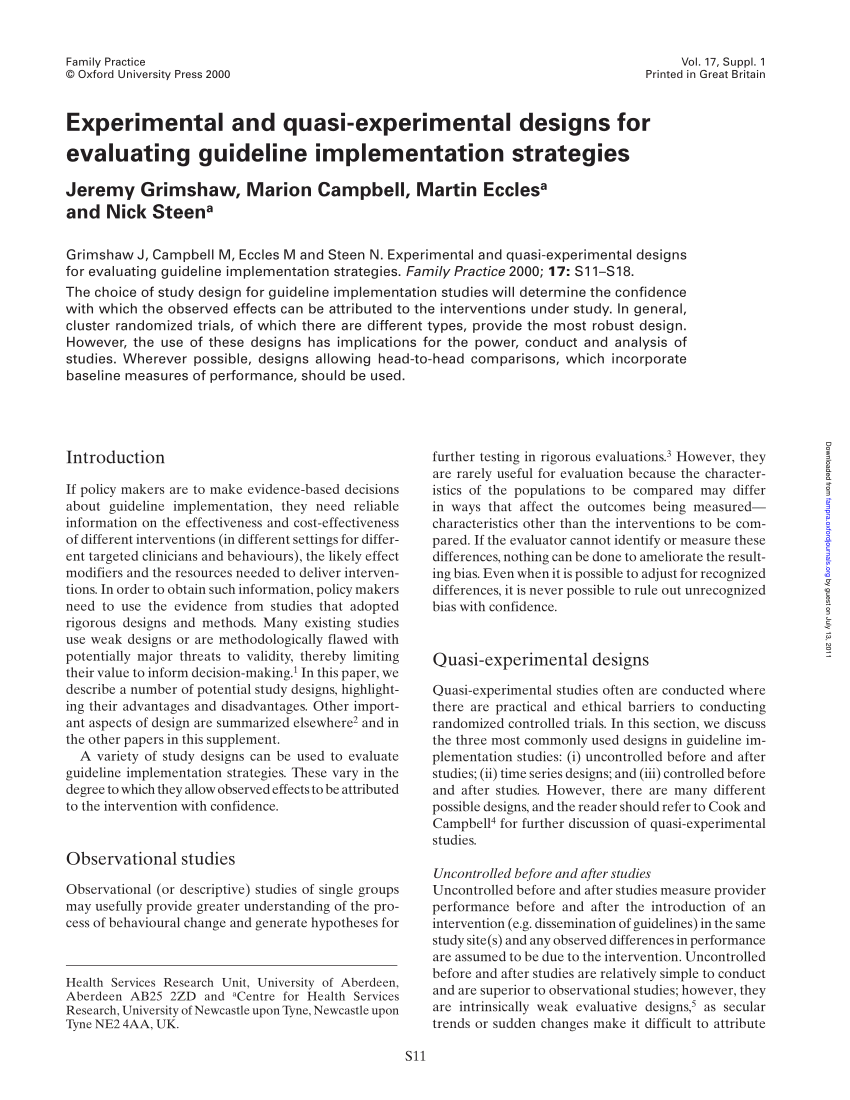
When a design using randomized locations is employed successfully, the locations may be different in other respects (confounding variables), and this further complicates the analysis and interpretation. Quasi-experiments are studies that aim to evaluate interventions but that do not use randomization. Similar to randomized trials, quasi-experiments aim to demonstrate causality between an intervention and an outcome. Quasi-experimental studies can use both preintervention and postintervention measurements as well as nonrandomly selected control groups.
Institutional access
Quasi-experimental designs are used when researchers don’t want to use randomization when evaluating their intervention. The true experimental design may be impossible to accomplish or just too expensive, especially for researchers with few resources. Quasi-experimental designs enable you to investigate an issue by utilizing data that has already been paid for or gathered by others (often the government). Overall, the purpose of quasi-experimental design is to provide a rigorous method for evaluating the impact of interventions, policies, and programs while controlling for potential confounding factors that may affect the outcome.
Quasi-Experimental Research Designs
By leveraging InsightsHub, the unified hub for data management, you can leverage the consolidated platform to organize, explore, search, and discover your research data in one organized data repository. However, because they couldn’t afford to pay everyone who qualified for the program, they had to use a random lottery to distribute slots.
Pretest-Posttest Design
In the most controlled situations within this design, the investigators might include elements of randomization or matching for individuals in the intervention or comparison site, to attempt to balance the covariate distribution. Implicit in this approach is the assumption that the greater the similarity between groups, the smaller the likelihood that confounding will threaten inferences of causality of effect for the intervention (33, 47). Thus, it is important to select this group or multiple groups with as much specificity as possible.
Implementing quality-of-care during labour, childbirth, and early postnatal care, northeast Namibia: a quasi ... - Journal of Global Health Reports
Implementing quality-of-care during labour, childbirth, and early postnatal care, northeast Namibia: a quasi ....
Posted: Mon, 11 Dec 2023 08:00:00 GMT [source]
Workplace financial education and change in financial knowledge: A quasi-experimental approach (Horwitz et al.,
For example in the Campus Watch intervention (16), the investigator over-sampled the Maori indigenous population in order to be able to stratify the results and investigate whether the program was effective for this under-studied group. In the study by Zombré et al (52) on health care access in Burkina Faso, the authors examined clinic density characteristics to determine its impact on sustainability. If the average posttest score is better than the average pretest score, then it makes sense to conclude that the treatment might be responsible for the improvement. Unfortunately, one often cannot conclude this with a high degree of certainty because there may be other explanations for why the posttest scores are better.
As with most large systems, there were occasional outages when the system unexpectedly became unavailable. Workers who had previously been using the system now had to answer questions without access to it, and nonetheless they continued to outperform those who had never used the system. Since the cutoff score used to determine eligibility for enrollment is arbitrary, researchers can assume that the disparity between students who only just fail to achieve the cutoff point and those who barely pass is a small margin and is due to the difference in the schools that these students attend. Researchers prefer to apply quasi-experimental design when there are ethical or practical concerns. Even though quasi-experimental design has been used for some time, relatively little is known about it.
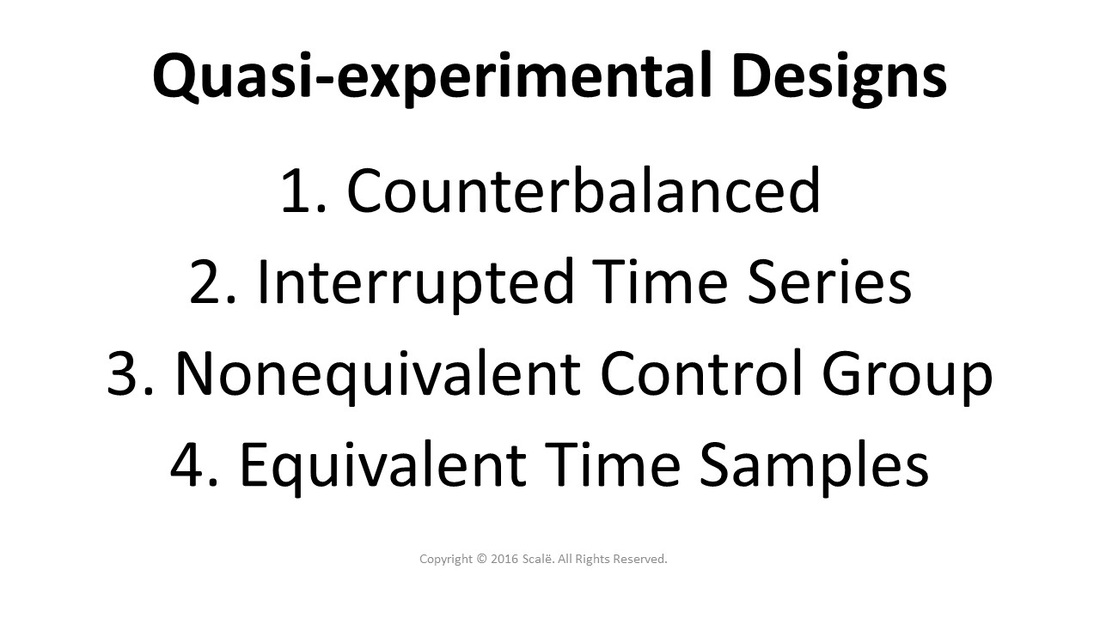
Although quasi-experimental study designs are ubiquitous in the medical informatics literature, as evidenced by 34 studies in the past four years of the two informatics journals, little has been written about the benefits and limitations of the quasi-experimental approach. As we have outlined in this paper, a relative hierarchy and nomenclature of quasi-experimental study designs exist, with some designs being more likely than others to permit causal interpretations of observed associations. Strengths and limitations of a particular study design should be discussed when presenting data collected in the setting of a quasi-experimental study. Future medical informatics investigators should choose the strongest design that is feasible given the particular circumstances. An interrupted time-series design is one in which a string of consecutive observations equally spaced in time is interrupted by the imposition of a treatment or intervention.
Effects of symptom management program on selected health outcomes among older people with chronic obstructive ... - Nature.com
Effects of symptom management program on selected health outcomes among older people with chronic obstructive ....
Posted: Thu, 14 Dec 2023 08:00:00 GMT [source]
Quasi-Experimental Research Designs : Clinical Nurse Specialist
Because productivity increased rather quickly after the shortening of the work shifts, and because it remained elevated for many months afterward, the researcher concluded that the shortening of the shifts caused the increase in productivity. Notice that the interrupted time-series design is like a pretest-posttest design in that it includes measurements of the dependent variable both before and after the treatment. It is unlike the pretest-posttest design, however, in that it includes multiple pretest and posttest measurements.
This can help to reduce the impact of confounding variables that may affect the study’s results. We also note that there are a variety of Single Subject Experimental Designs (SSEDs; Byiers et al., 2012), including withdrawal designs and alternating treatment designs, that can be used in testing evidence-based practices. Similarly, an implementation strategy may be used to encourage the use of a specific treatment at a particular site, followed by that strategy’s withdrawal and subsequent reinstatement, with data collection throughout the process (on-off-on or ABA design). A weakness of these approaches in the context of implementation science, however, is that they usually require reversibility of the intervention (i.e. that the withdrawal of implementation support truly allows the healthcare system to revert to its pre-implementation state). When this is not the case—for example, if a hypothetical study is focused on training to encourage use of an evidence-based psychotherapy—then these designs may be less useful.
Commonly used in medical informatics (a field that uses digital information to ensure better patient care), researchers generally use this design to evaluate the effectiveness of a treatment – perhaps a type of antibiotic or psychotherapy, or an educational or policy intervention. Recall that when participants in a between-subjects experiment are randomly assigned to conditions, the resulting groups are likely to be quite similar. When participants are not randomly assigned to conditions, however, the resulting groups are likely to be dissimilar in some ways. A nonequivalent groups design, then, is a between-subjects design in which participants have not been randomly assigned to conditions. Frameworks can be helpful to enhances interpretability of many kinds of studies, including QEDs and can help ensure that information on essential implementation strategies are included in the results (44).
There are many different kinds of quasi-experiments, but we will discuss just a few of the most common ones here. External validity can be improved when the intervention is applied to entire communities, as with some of the community-randomized studies described in Table 2 (12, 21). In these cases, the results are closer to the conditions that would apply if the interventions were conducted ‘at scale’, with a large proportion of a population receiving the intervention. Unlike a true experiment, in a quasi-experimental study the choice of who gets the intervention and who doesn’t is not randomized. Instead, the intervention can be assigned to participants according to their choosing or that of the researcher, or by using any method other than randomness. A category of alternative explanations for differences between scores such as events that happened between the pretest and posttest, unrelated to the study.
The tendency for many medical and psychological problems to improve over time without any form of treatment. Researchers can then examine the long-term effects of these two groups of kids to determine the effect of attending certain schools. This information can be applied to increase the chances of students being enrolled in these high schools. A hypothetical quasi-experimental study was conducted in an economically developing country in a mid-sized city. As a result, in terms of internal consistency, quasi-experiments fall somewhere between correlational research and actual experiments. We present a decision ‘map’ approach based on a Figure 5 to assist in considering decisions in selecting among QEDs and for which features you can pay particular attention to in the design [Figure 5 here].
Imagine, for example, a researcher who wants to evaluate a new method of teaching fractions to third graders. One way would be to conduct a study with a treatment group consisting of one class of third-grade students and a control group consisting of another class of third-grade students. This design would be a nonequivalent groups design because the students are not randomly assigned to classes by the researcher, which means there could be important differences between them. For example, the parents of higher achieving or more motivated students might have been more likely to request that their children be assigned to Ms. Williams’s class. Or the principal might have assigned the “troublemakers” to Mr. Jones’s class because he is a stronger disciplinarian. Of course, the teachers’ styles, and even the classroom environments, might be very different and might cause different levels of achievement or motivation among the students.
This design involves selecting two groups of participants that are similar in every way except for the independent variable(s) that the researcher is testing. One group receives the treatment or intervention being studied, while the other group does not. The two groups are then compared to see if there are any significant differences in the outcomes. Detailed reviews have been published of variations on the basic ITS design that can be used to enhance causal inference. In particular, the addition of a control group can be particularly useful for assessing for the presence of seasonal trends and other potential time-varying confounders (52).


No comments:
Post a Comment